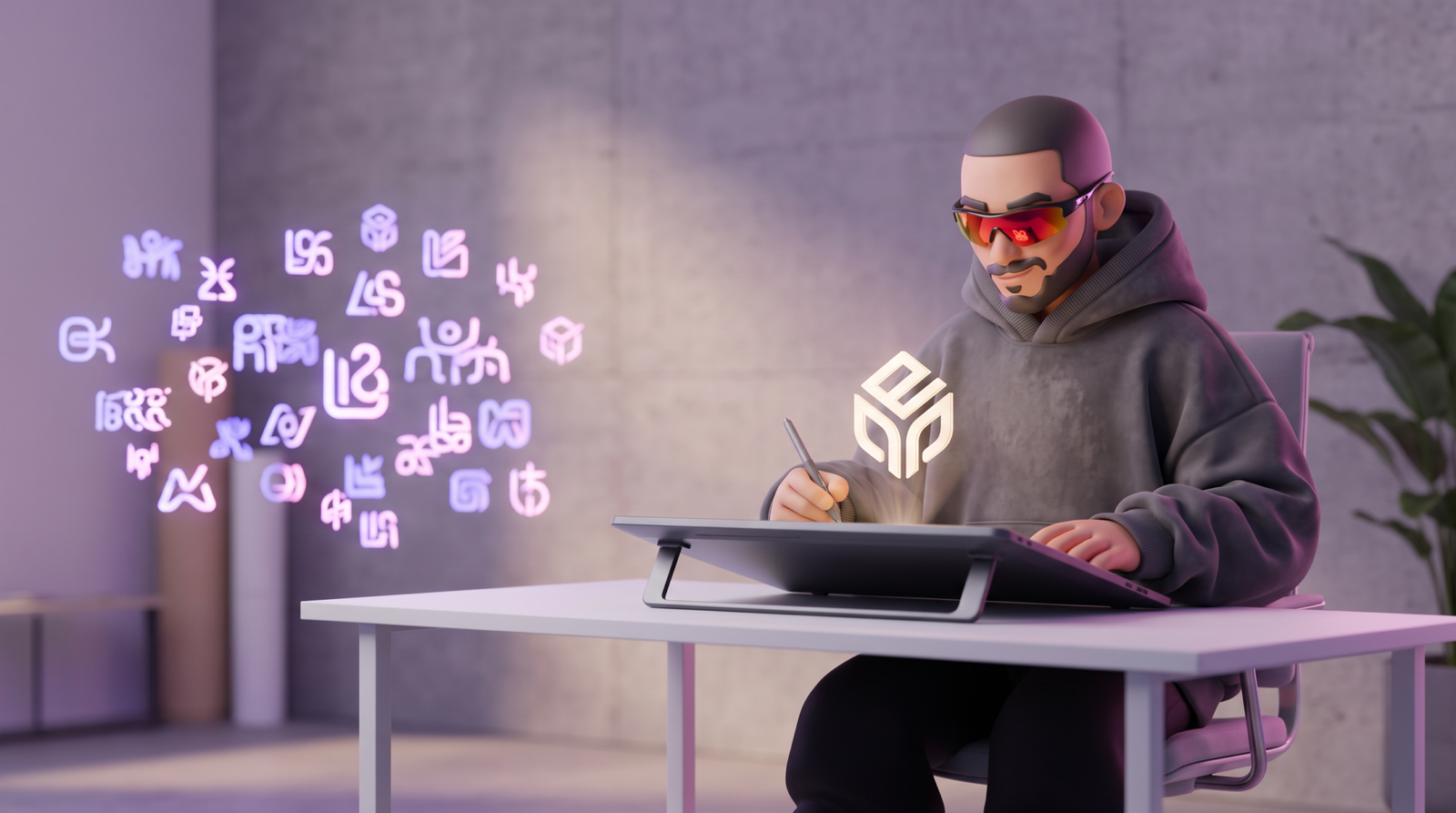
Today anyone can write one line and get dozens of logos in seconds. I use AI every day, and it's a central part of my work.
But a logo isn't a brand, and a nice image isn't a strategy. The right question isn't “AI or a designer”, but who decides what's right for your business.
What AI does well, and what it doesn't
| AI alone | A designer working with AI | |
|---|---|---|
| Speed of ideas | Excellent | Excellent |
| Understanding the business and audience | None | The foundation of the work |
| Uniqueness | Tends to look like everyone else | Built around your story |
| A complete language (colors, fonts, rules) | A single file | A system that works everywhere |
| Files for print and signage | An image that can't be enlarged | A clean vector at any size |
| Rights | Not always yours | Secured in a contract |
Pay attention to the rights. In the US, according to the Copyright Office, content created entirely by AI isn't protected by copyright, and a prompt alone isn't enough. In addition, models trained on millions of logos may produce something similar to an existing brand. This isn't legal advice, but it's a good reason to check before printing a sign.
How I build AI into the process
- Strategy, without AI. A conversation about the business, the audience and the competitors. This is where the direction is set.
- Ideas with AI. Mood boards, atmosphere and quick mockups, to see dozens of directions instead of two.
- The logo and the language, by hand. Drawing, grid, fonts, colors, a clean vector that's yours alone.
- Content and mockups, with AI. Mockups of signs, packaging and scenes that used to cost thousands.
That's how you get the speed of AI and a designer's thinking, without looking like everyone else. Want a brand built like this? Send me a message with the word “brand”.
Source: Bloomberg Law